What you'll learn
On this page
Most traders who give up on gold do not fail because their analysis was wrong. They fail because one bad week took too much of their account, or because they kept trading after they stopped thinking clearly. This lesson covers the two things that keep you in the game long enough for your skills to matter: risk management and trading psychology.
Risk a fixed small amount per trade
Decide, before every trade, how much of your account you are willing to lose if the stop is hit. Many experienced traders keep this between 0.5% and 1%, and rarely above 2%. The number is personal, but it must be decided before entry and stay the same from trade to trade.
Why so small? Because losing streaks are normal, even for a good strategy. With a win rate of 40%, the chance of seeing at least one run of six losses in a row over 100 trades is about 87%. With a 50% win rate it is still about 55%.
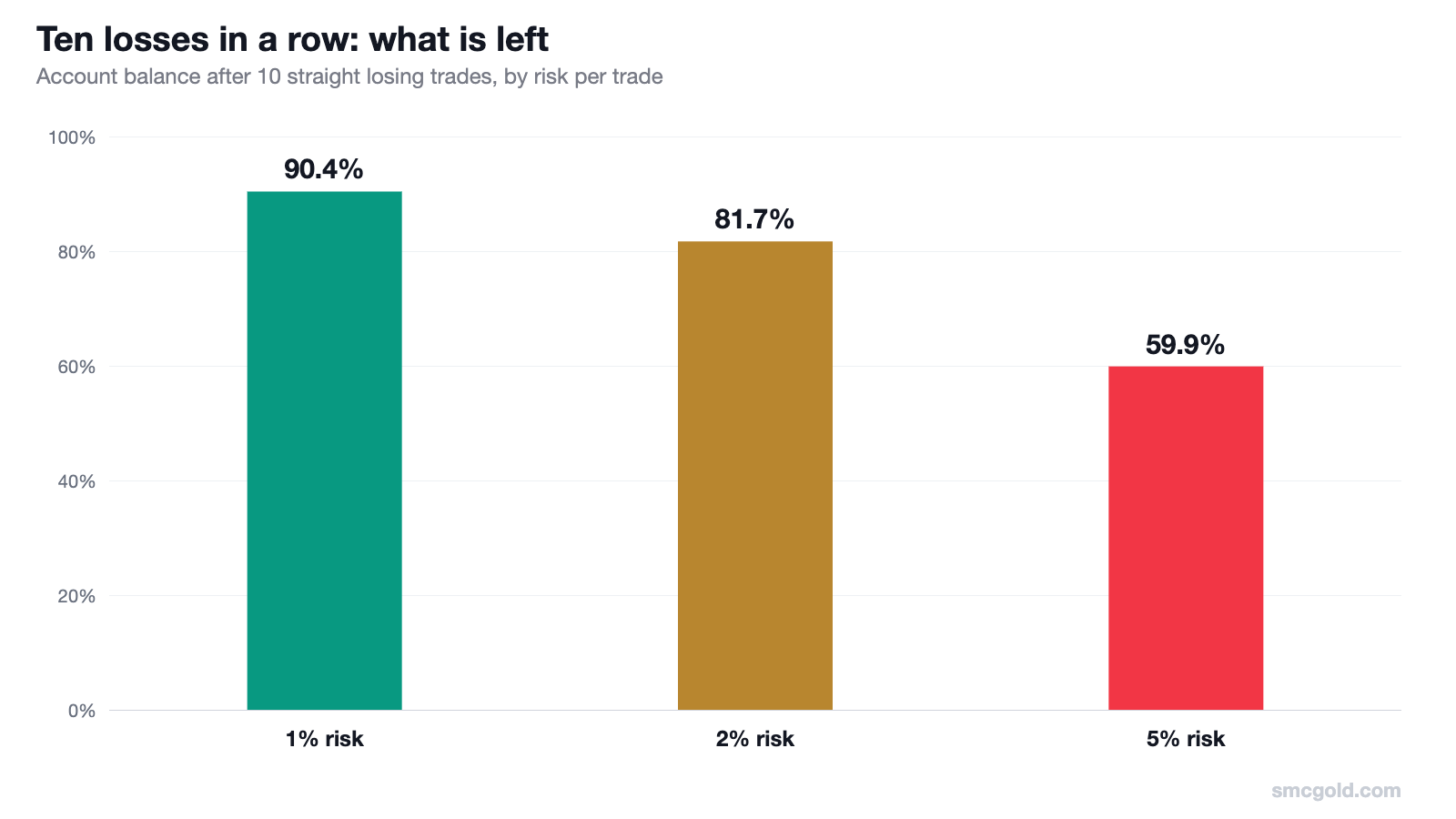
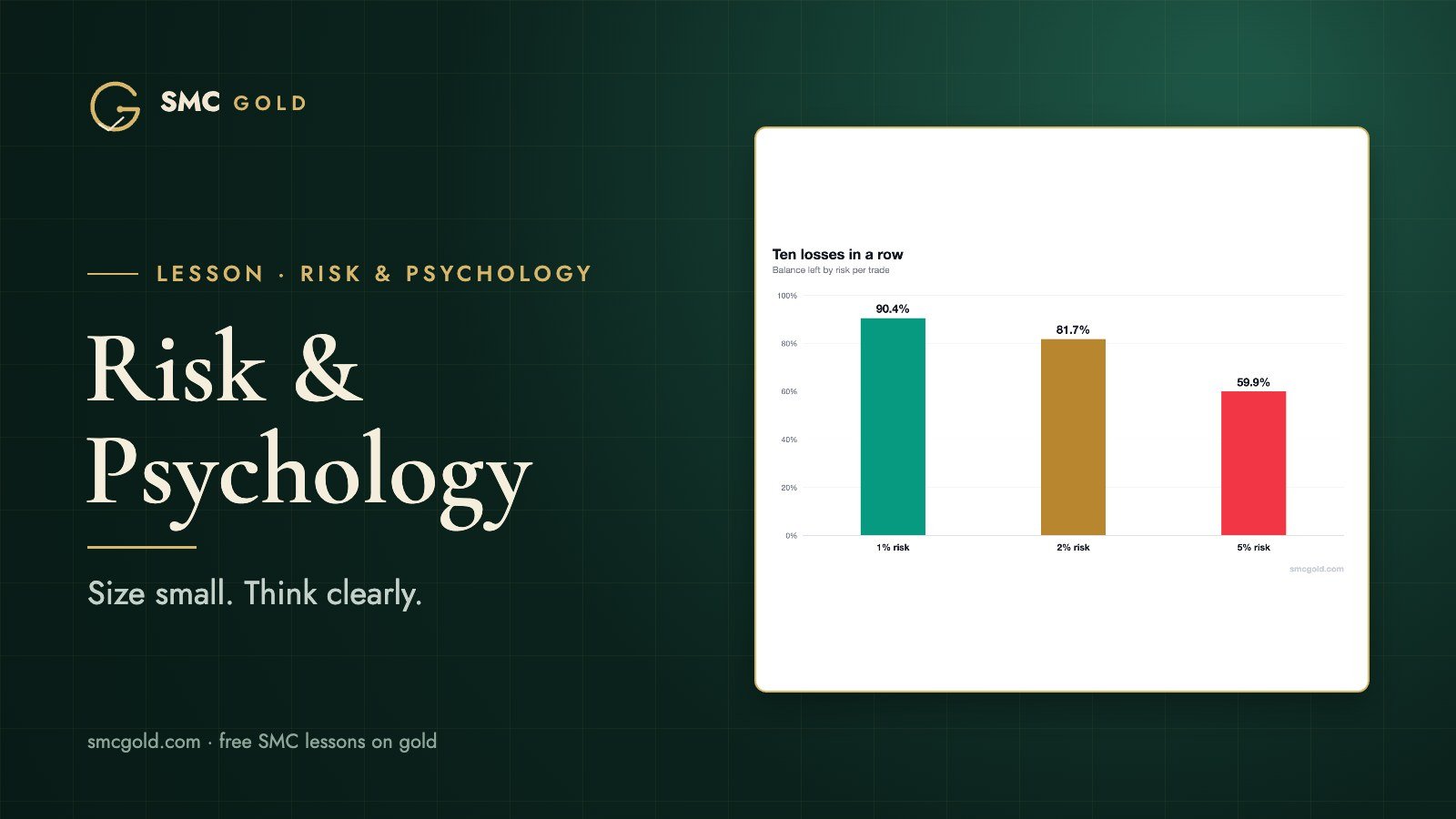
At 1% risk, ten straight losses leave you with about 90% of your account: annoying, but recoverable. At 5% risk, the same streak leaves about 60%, and the hole becomes very hard to climb out of.
How to calculate your position size on gold
Position size comes from your stop, not from how confident you feel. Work it out in four steps:
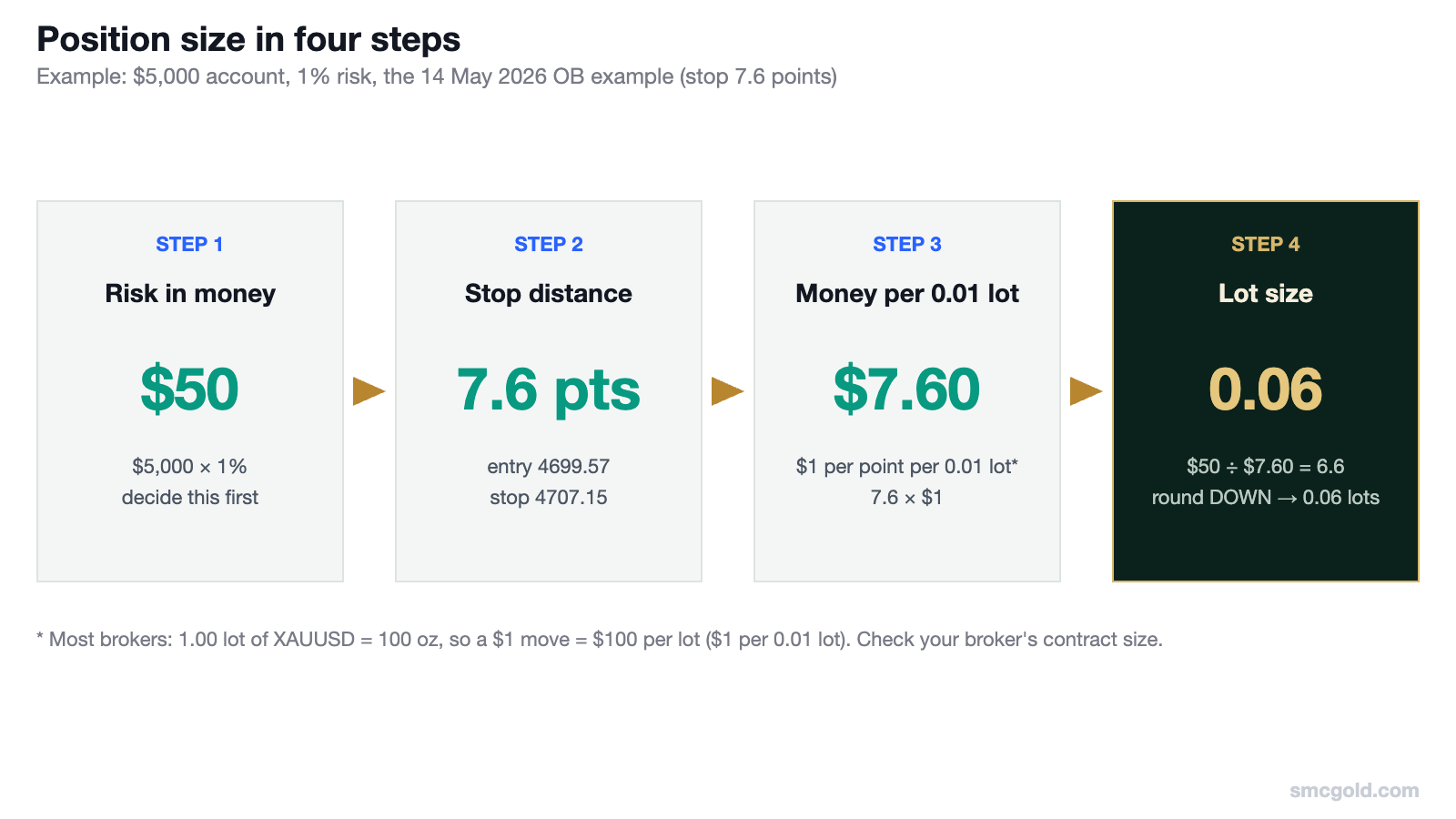
- Risk in money: account × risk %. For a $5,000 account at 1%, that is $50.
- Stop distance: from entry to stop, in points. In the order block example, entry 4,699.57 and stop 4,707.15 give 7.6 points.
- Value per point: with most brokers, 1.00 lot of XAUUSD is 100 ounces, so each $1 move is worth $100 per lot, or $1 per 0.01 lot. Check this in your broker's contract specifications.
- Lot size: $50 ÷ (7.6 × $1) = 6.6, so 0.06 lots. Always round down.
Rule of thumb: a wider stop means a smaller position. If a setup needs a stop so wide that your size drops below your broker's minimum, skip the trade.
The maths of drawdown
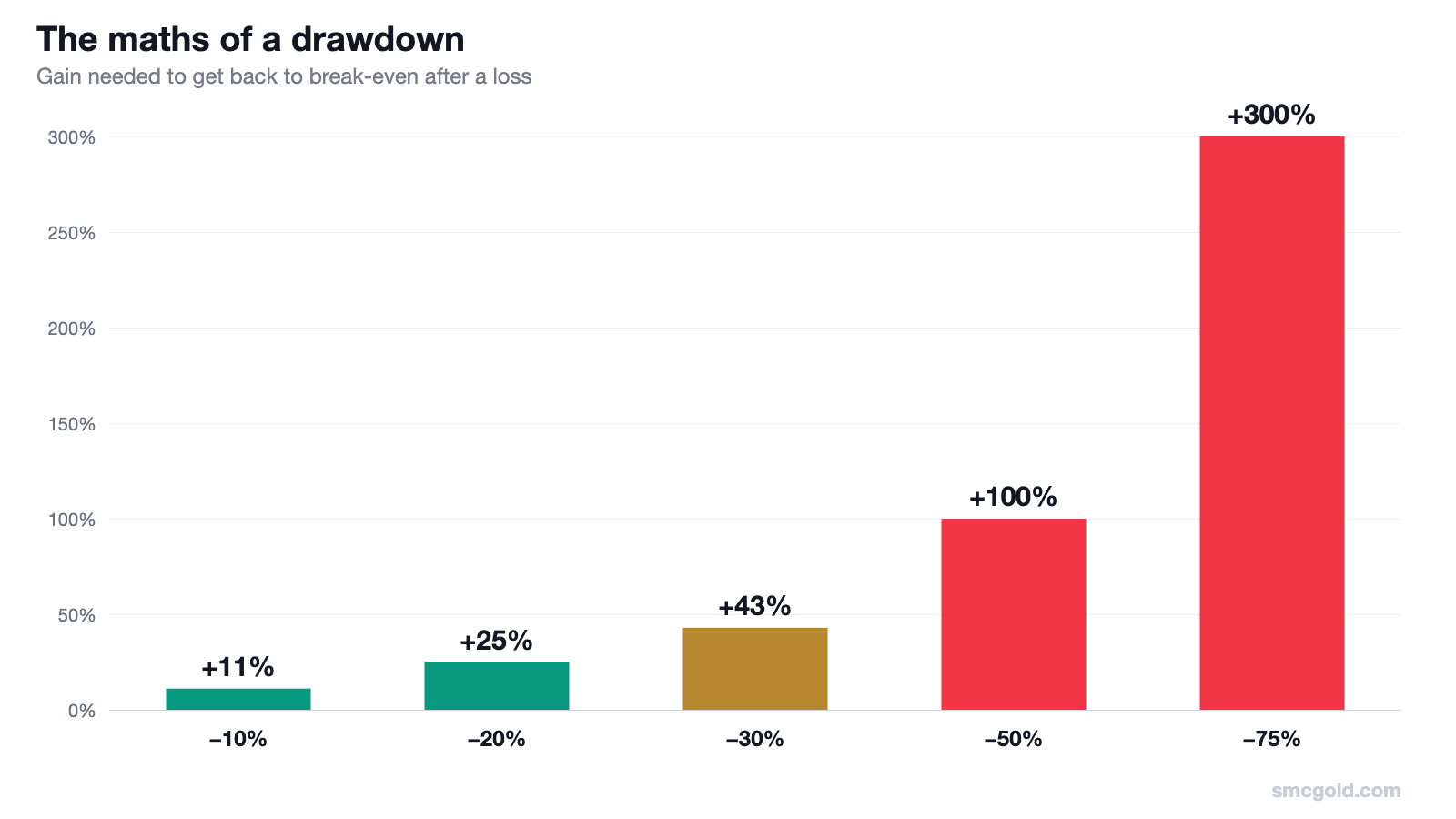
Losses and gains are not equal. A 50% loss needs a 100% gain just to get back to where you started. This is why protecting the account matters more than chasing one big winner.
Set yourself loss limits as well as a per-trade risk. For example: stop trading for the day after two losses, and take a full break to review after a 6% drawdown from your account high.
The four emotions that cost gold traders money
- Fear of missing out (FOMO). Gold moves fast, and a big green candle makes you want to jump in. Entering in the middle of a move, far from your zone, gives you a bad price and a wide stop. If you missed it, you missed it; there is another setup tomorrow.
- Revenge trading. After a loss, the urge to "get it back" leads to bigger size and weaker setups. A loss you planned for is not a reason to trade again.
- Overconfidence after wins. A winning streak tempts you to double your size. Keep the risk the same; the market does not know you are on a streak.
- Hope. Moving your stop further away because price "should" turn turns a small planned loss into a large unplanned one. If the reason for the trade is gone, the trade should be gone too.
Build a routine that protects you
- Before the session: check the economic calendar, mark your higher-timeframe levels, and write down the one or two setups you are waiting for.
- Before each trade: confirm the setup matches your plan, calculate the size, and set the stop and target in the platform before you enter.
- During the trade: do not move the stop further away. Moving it to break-even after a clear structure shift is a plan; moving it because you are scared is not.
- After the session: record every trade in a journal, win or lose.
Keep a trading journal
A journal turns feelings into data. For every trade, write down:
| Field | Example |
|---|---|
| Date, session, timeframe | 14 May 2026, Asia, 15m |
| Setup | BSL sweep, CHoCH, OB of the CHoCH leg |
| Entry, stop, target, size | 4,699.57 / 4,707.15 / 4,677.63 / 0.06 lots |
| Result in R | +2.9R or −1R |
| Did I follow my plan? | Yes / No, and why |
| How did I feel? | Calm, rushed, angry after a loss… |
After 20 to 30 trades, patterns appear: the session where you trade best, the setups that actually work for you, and the mistakes you repeat when tired or frustrated.
Remember: no risk rule removes risk. Trading leveraged gold can lose you more than you expect, very quickly. Only trade money you can afford to lose, and consider speaking to a licensed professional about your situation.
Quick checklist
- Risk per trade decided in advance (for example 0.5–1%)
- Position size calculated from the stop, rounded down
- Daily loss limit set and respected
- No entries out of FOMO or to win back a loss
- Stop never moved further away
- Every trade recorded in the journal
Risk warning. This article is for education only and is not financial advice. Trading forex and gold carries a high level of risk; you could lose some or all of your money. See our risk disclaimer.
Spotted a mistake? Send a correction.