What you'll learn
On this page
Every Smart Money Concepts setup begins with one question: where is the liquidity? If you can answer that before you look for an entry, you will understand why gold so often spikes through an obvious level, traps traders, and then moves hard the other way.
This guide takes you from the basic idea to a complete, step-by-step trading model, finishing with a real XAUUSD example. Read it in order; each section builds on the one before.
What liquidity means in trading
In SMC, liquidity simply means a cluster of orders waiting at a price. Most of those orders are stop losses and pending breakout orders. A common SMC interpretation is that large participants need many orders on the other side to fill big positions, and that clusters of stops provide that flow. Order flow is not visible on a candle chart, so treat this as a model that explains price behaviour, not a fact you can see.
So price is often drawn toward liquidity. When it reaches a pool, two things can happen: the pool is taken and price reverses (a sweep), or the pool is taken and price keeps going (a breakout). Telling the two apart is most of the skill.
Buy-side and sell-side liquidity
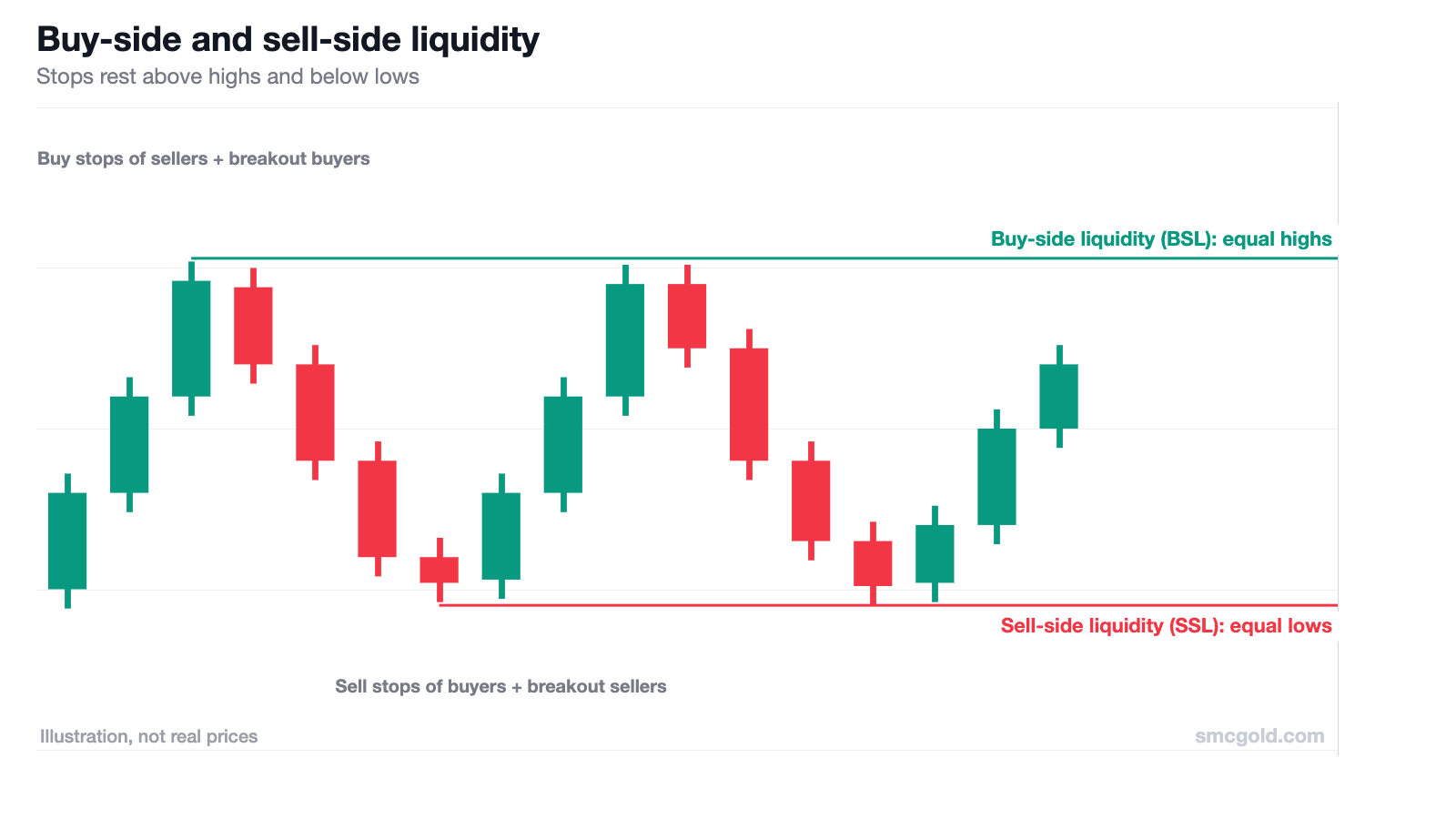
- Buy-side liquidity (BSL) rests above highs. It is made of the stop losses of traders who are short, plus buy-stop orders from breakout traders. When price trades above a high, those orders become buy orders.
- Sell-side liquidity (SSL) rests below lows. It is made of the stop losses of traders who are long, plus sell-stop orders from breakout traders. When price trades below a low, those orders become sell orders.
A simple way to remember it: above a high = buy stops = BSL; below a low = sell stops = SSL.
Where liquidity builds up
Not every high or low holds the same amount of liquidity. Look for levels that many traders can see and are likely to protect with a stop:
- Equal highs and equal lows. Two or more touches at nearly the same price. Retail traders see "double tops" and "support"; SMC traders see a pool of stops.
- Clear swing highs and swing lows on the timeframe you trade, especially the last swing before a strong move.
- Session highs and lows, such as the Asian range high and low before London opens.
- Previous day, week and month highs and lows. These are watched by almost everyone.
- Trendline touches. Three neat touches on a trendline invite stops just beyond it.
- Round numbers on gold, such as 4,300 or 4,250, where many orders are placed.
Tip: the more obvious a level looks, the more stops sit behind it, and the more likely it is to be run before the real move.
Internal and external liquidity
Think of the current trading range as a box. The highest high and lowest low of that range are external liquidity. Everything in between, such as minor swing points and fair value gaps, is internal liquidity.
Price usually moves from one to the other: after taking external liquidity (for example, sweeping the range low), it often travels back toward internal liquidity or all the way to the external liquidity on the other side. This gives you a logical target before you even enter.
Session liquidity: the Asian range
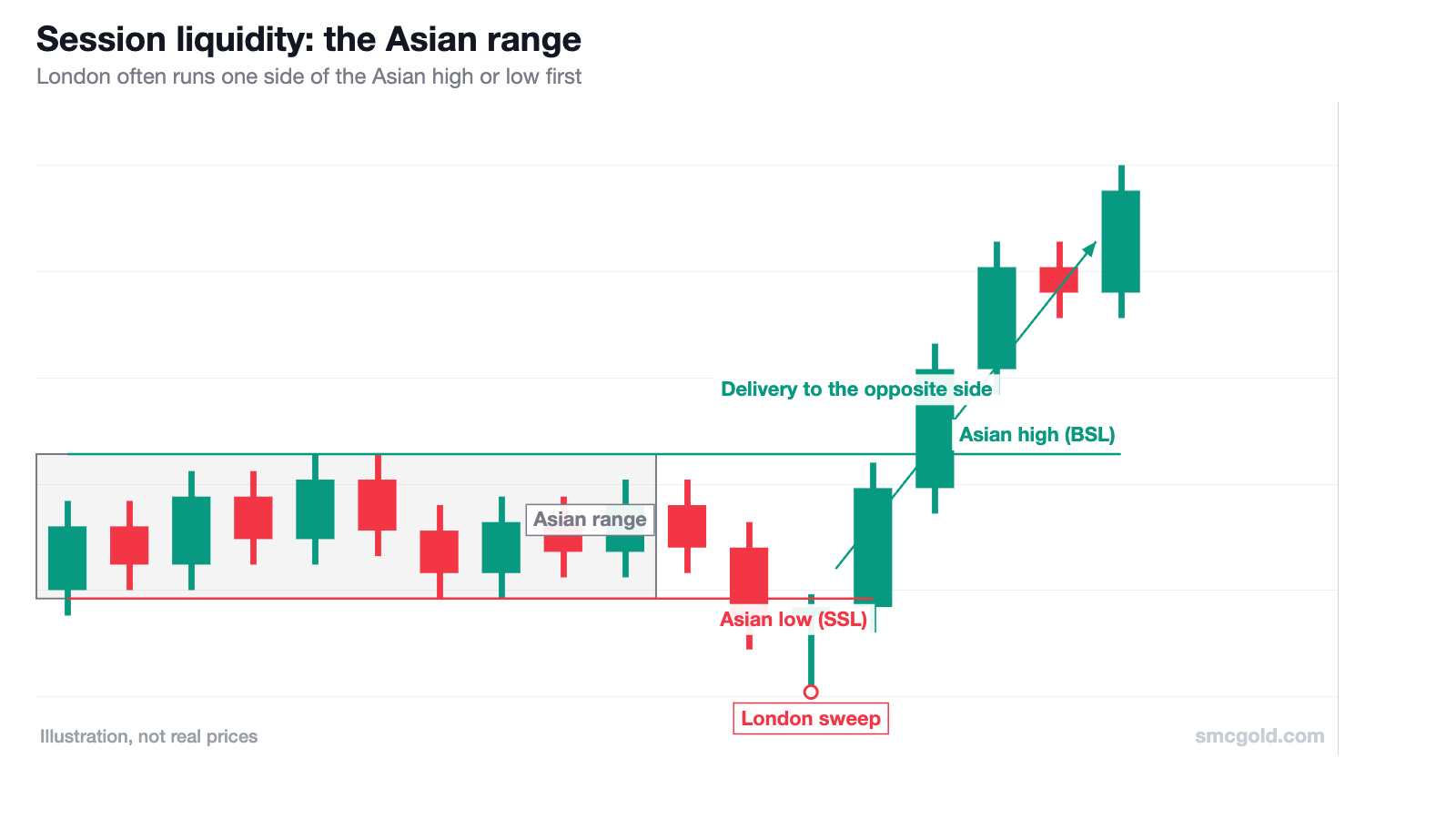
On gold, the Asian session often forms a tight range. Its high and low collect stops overnight. When London opens, price frequently runs one side of that range first. A sweep of the Asian low followed by a shift in structure can set up a move toward the Asian high and beyond. The same idea works in reverse.
This is a tendency, not a rule. Sometimes London breaks the range and never looks back, which is why the next section matters.
Sweep or breakout: how to tell the difference
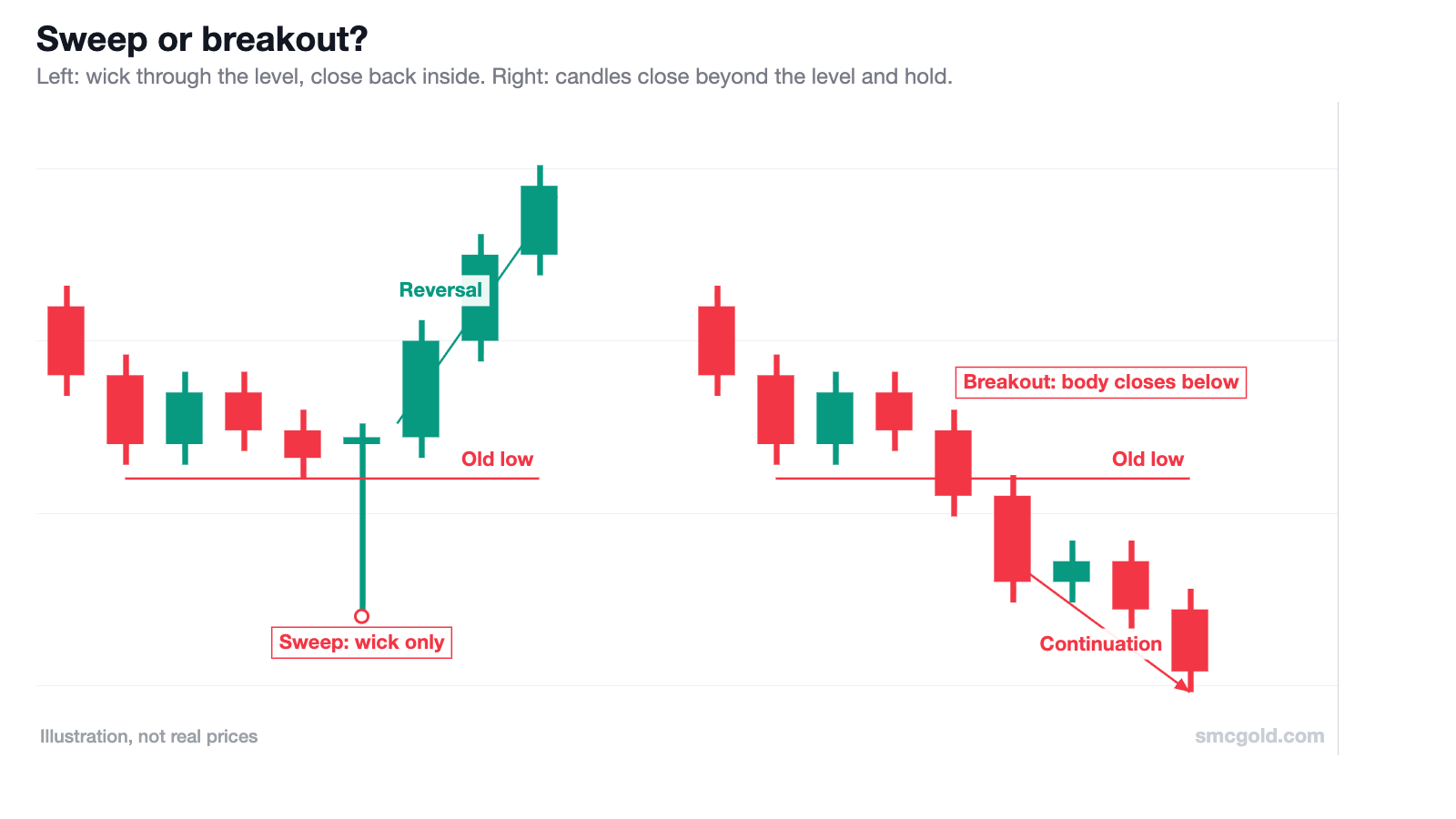
A sweep (also called a liquidity grab or stop hunt) trades through the level with a wick, then the candle closes back inside the range. The stops are filled, the move runs out of fuel, and price often reverses.
A breakout closes with a full body beyond the level and keeps closing there. The liquidity was used to continue, not to reverse.
Check these four things before calling it a sweep:
- Did a candle close back inside the level within one or two candles?
- Was the move into the level tired (small candles), with a sharp rejection after it?
- Does the higher timeframe have room to move the other way?
- Do you then see a change of character (CHoCH) on your entry timeframe? Without it, you do not have a trade yet.
Inducement: the trap before the trap
Inducement is a small, obvious high or low that forms just before price reaches a real point of interest, such as an order block. It tempts traders to enter early. Price often takes that small pool of liquidity first, then reaches the real zone. If you see a tempting minor low sitting just above your order block, expect it to be taken before your zone is tested.
The liquidity model, step by step
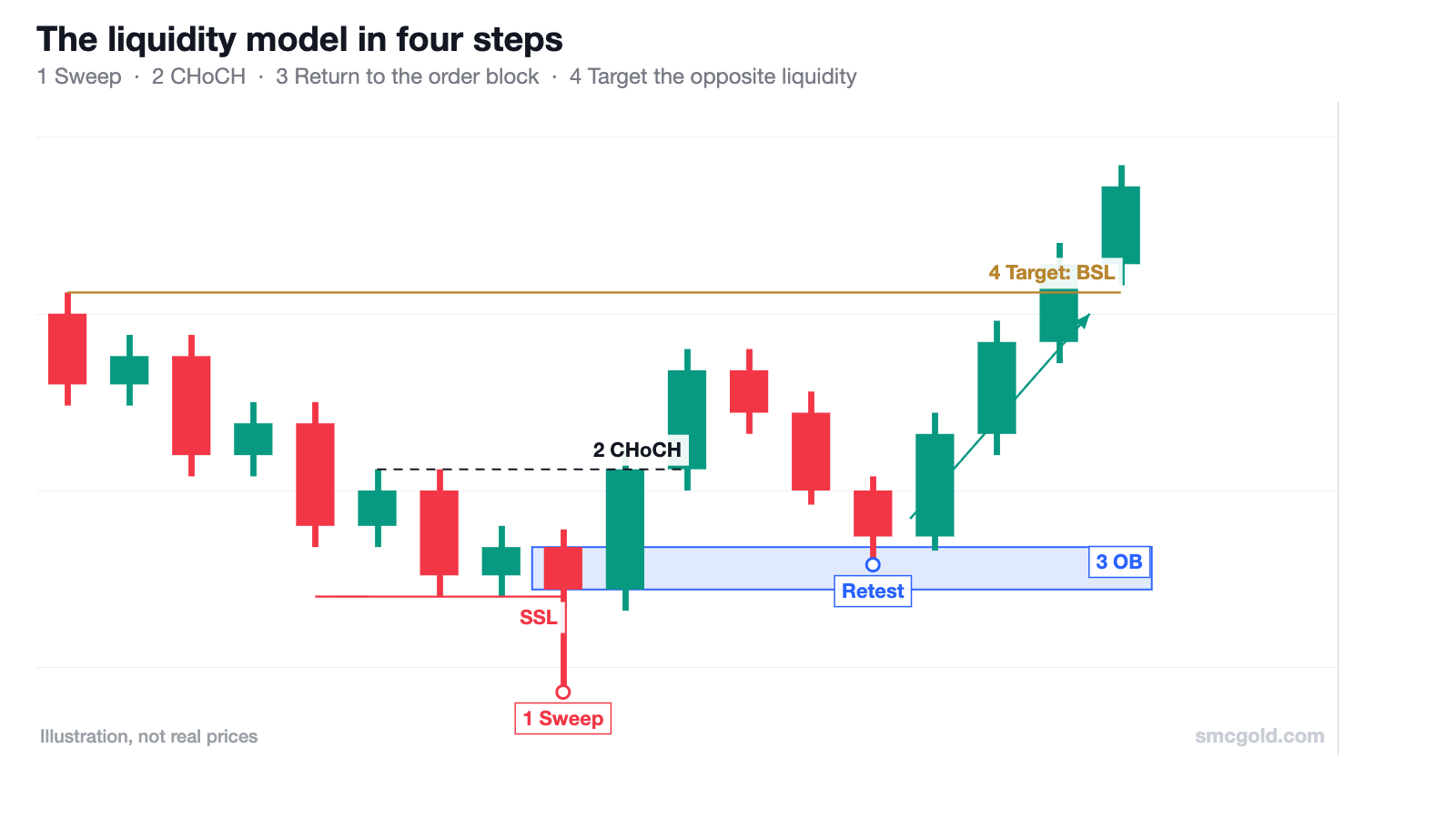
- Mark the liquidity. On the higher timeframe (4H or 1H), mark the obvious pools on both sides and decide which one price is more likely to reach.
- Wait for the sweep. Let price take one side. Do not enter while it is happening.
- Wait for the CHoCH. On your entry timeframe (15m or lower), price must break the last swing in the opposite direction with a candle body close.
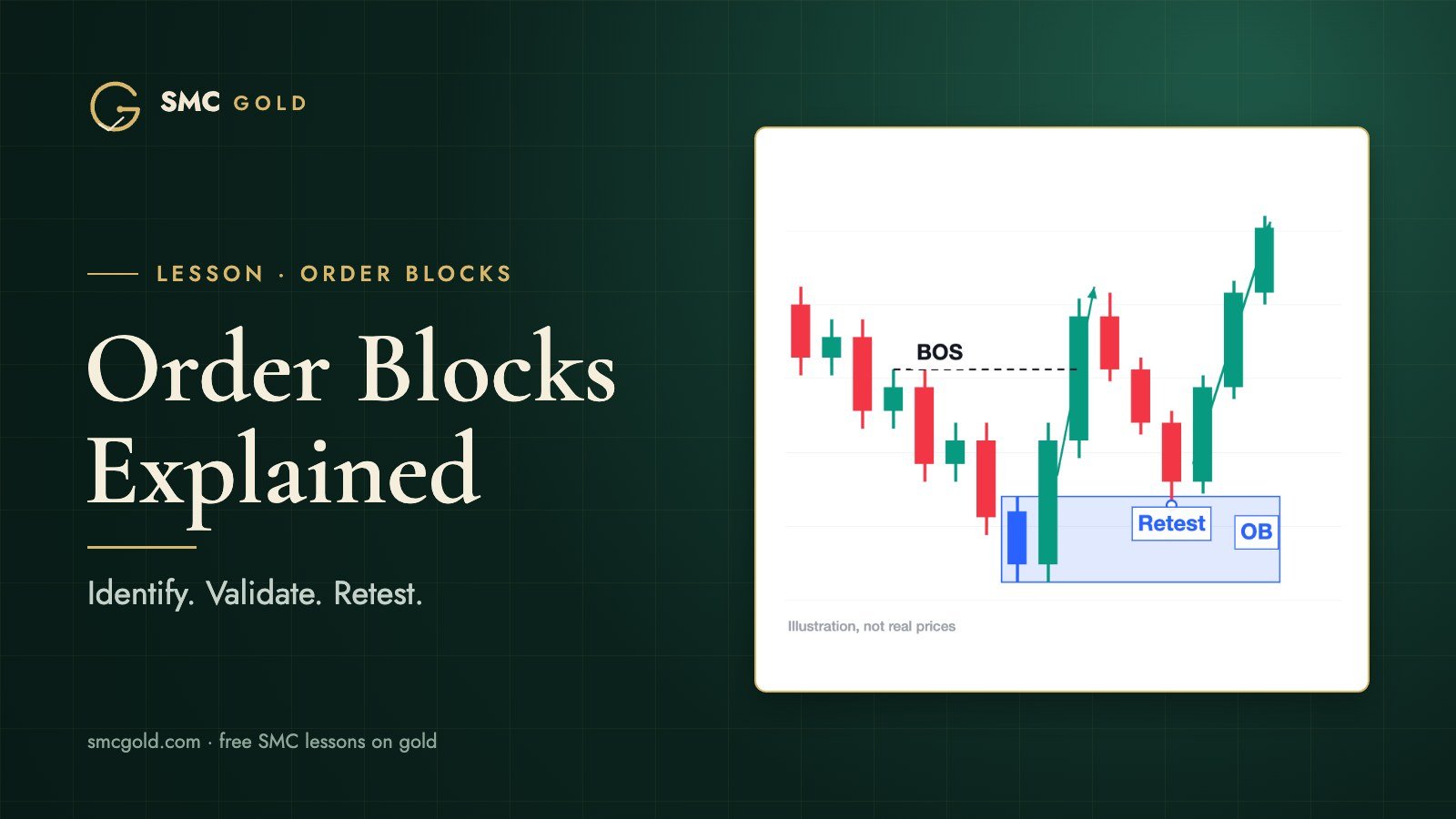
- Enter at the order block of the CHoCH leg. The last opposite candle before the move that caused the CHoCH is your zone. Wait for price to return to it. The order block lesson covers this step in detail.
- Stop and target. Place the stop beyond the sweep extreme. Target the liquidity on the other side: the opposite equal highs or lows, or the external range high or low.
Real example: XAUUSD, 23 September 2026
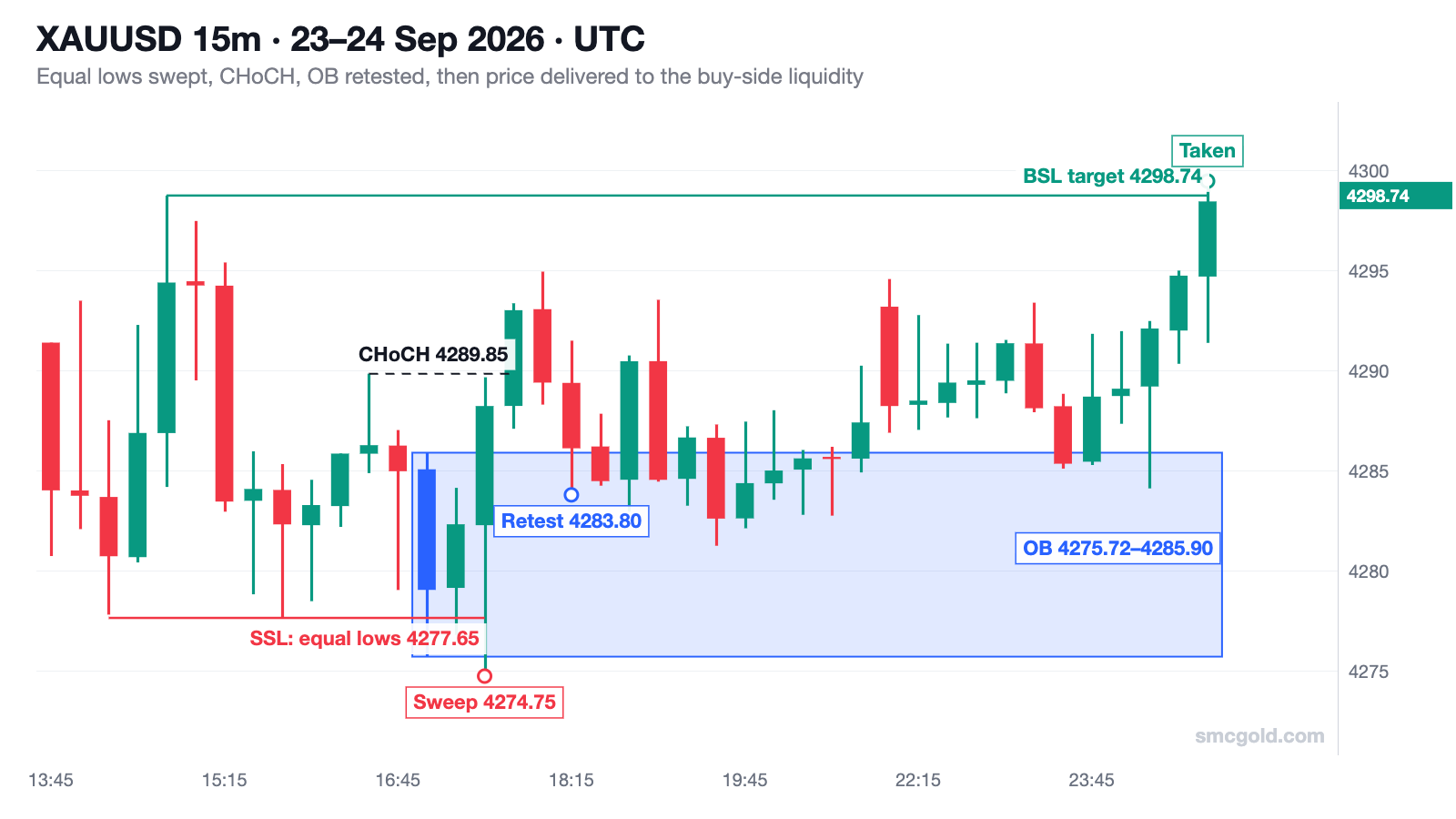
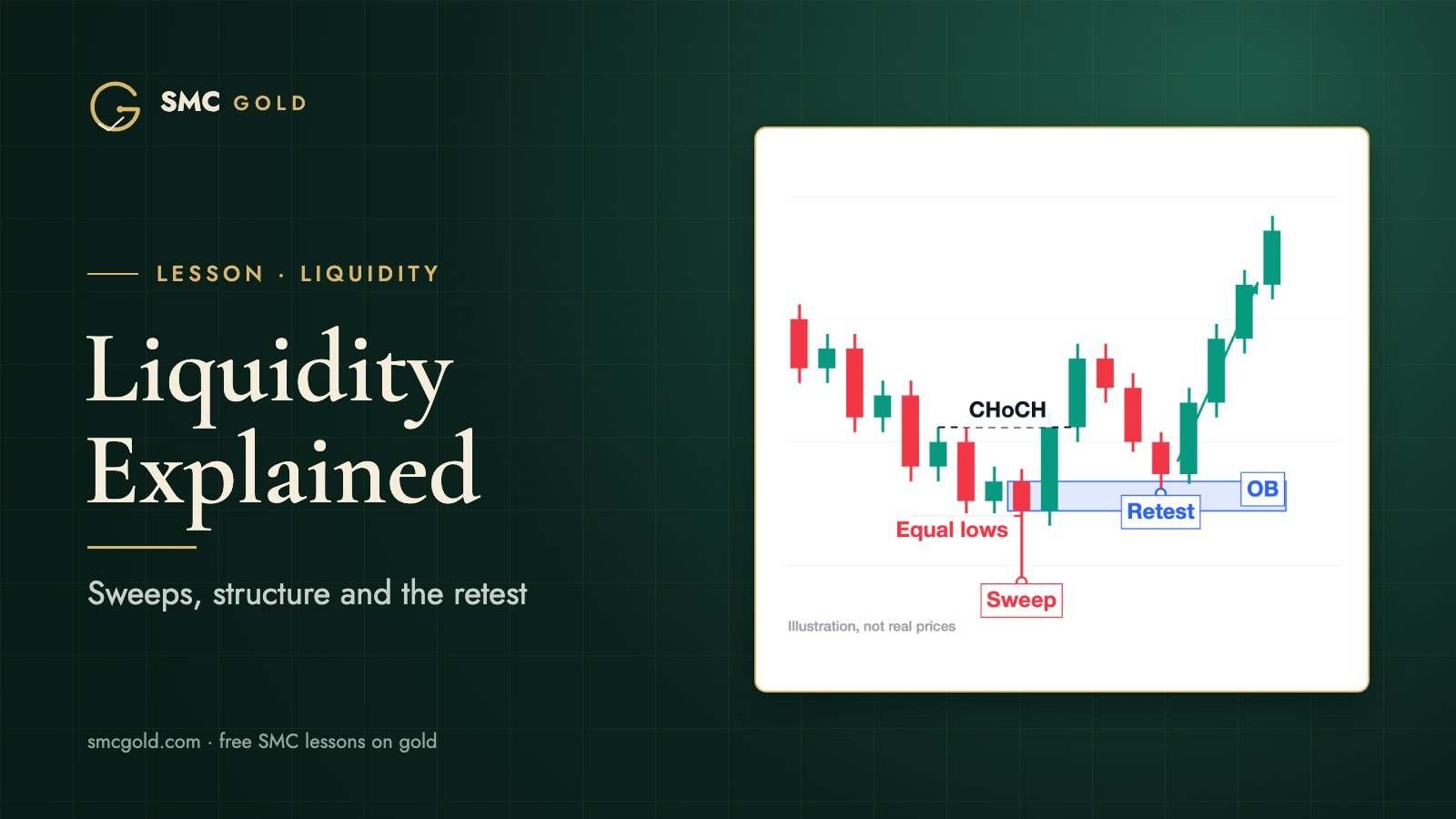
On the 15-minute chart, gold made three lows within a few cents of each other between 14:15 and 16:00 UTC (4277.82, 4277.65 and 4278.49). That is a textbook pool of sell-side liquidity.
- Sweep: at 17:00 and 17:30 UTC, price traded below the equal lows to 4274.75, but the 17:30 candle closed back up at 4288.23.
- CHoCH: the 17:45 candle closed at 4293.02, above the last lower high at 4289.85. Structure had shifted to bullish.
- Order block: the last down candle before the move up, at 17:00 UTC, spans 4275.72 to 4285.90. This is the OB of the CHoCH leg.
- Retest: at 18:15 UTC price pulled back into the OB (low 4283.80), dipped once more to 4281.25 at 19:30, held above the zone low and then moved up.
- Target: the obvious buy-side liquidity was the 14:45 high at 4298.74. Price traded through it at 00:45 UTC on 24 September (high 4299.46).
A hypothetical entry at the top of the OB (4285.90), with a stop below the sweep low (4274.75), would have risked about 11.2 points for about 12.8 points to the target, a little more than 1 times the risk. These are chart prices, not a broker fill. Price spent several hours moving sideways inside and above the zone before reaching the target, so patience mattered. A trader who bought during the sweep, before the CHoCH, would have had no confirmation at all.
Hindsight warning: this example was chosen after the fact to show the concept clearly. Many sweeps fail, and many equal lows break cleanly. Treat it as a picture of the idea, not as proof that it always works.
Common mistakes
- Entering during the sweep. You cannot know a sweep is a sweep until price closes back inside and structure shifts.
- Marking every tiny high and low. Focus on levels that are obvious on your higher timeframe.
- Ignoring the higher timeframe. A 15m sweep against a strong 4H trend has a lower chance of working.
- Putting your own stop exactly where everyone else does. Give it room beyond the sweep extreme, and size the position so that the loss is acceptable.
- Trading during major news. Releases such as US CPI or NFP can run both sides of liquidity in seconds.
Quick checklist
- Higher timeframe liquidity marked on both sides
- One side swept, with a close back inside
- CHoCH on the entry timeframe with a body close
- Order block of the CHoCH leg marked; wait for the return
- Stop beyond the sweep; target the opposite liquidity
- Risk per trade decided before entry
Next, learn exactly how to find and grade the zone you will enter from in Order Blocks Explained.
Risk warning. This article is for education only and is not financial advice. Trading forex and gold carries a high level of risk; you could lose some or all of your money. See our risk disclaimer.
Spotted a mistake? Send a correction.